

The Millionaire: Soviet Cartoon Mocks Capitalist Ideology
Children, like soft wax, are very malleable and they should be molded into good Communists
- Soviet Educational Theorist
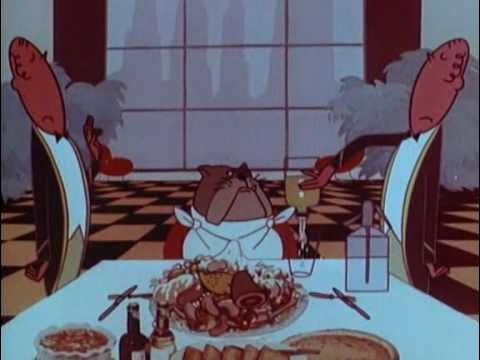
The Millionaire (1963), an eleven-minute cartoon, tells the story of a bulldog who becomes rich by inheriting his owner’s estate. Directed by Vitold Bordzilosky and Yuriy Prytkov, the film mocks capitalist ideology and exposes the corruption of Western democracy. The film was produced by the major Soviet studio Soyuzmultfilm as a piece of anti‑U.S. propaganda. Based in Russia, Soyuzmultfilm produced more than 1,500 cartoons and became the main production house for Soviet films. In 1938, they began to produce political films in the genres of the Soviet “political fairy tale,” political cartoons and propaganda posters. (Soyuzmultfilm)
The Millionaire’s message is that in capitalist societies, money alone grants social status and power, regardless of hard work, merit, or accomplishments. The film ridicules consumerism, and mocks American elites by referencing big cars, skyscrapers, nightclubs, abstract art, and jazz. These elements become symbols of capitalist extravagance. The film contains a nightclub scene that imitates American popular culture and attacks the local Western‑oriented youth counterculture of the 1950s. Known as “stilyagi,” Soviet youth counterculture appreciated American jazz music and flashy Western fashions. The Millionaire satirizes both foreign capitalism and local followers.
The Millionaire uses elements common to most types of Soviet propaganda, from posters to cinema and newspapers. It displays simple images, direct language, and stereotypical characters like the “greedy capitalist” and the “heroic worker.” According to New York Times film critic Dave Kehr, “Lenin proclaimed the cinema the most important of all the arts, presumably for its ability to communicate directly with the oppressed and widely illiterate masses.” Peasants and workers were a major target for propaganda films because they were seen as the backbone of the socialist economy. Given its cartoon format and simplistic message, the Millionaire could be understood by literate and illiterate populations and appealed to both children and adults.
An important goal of Soviet propaganda was to educate the youth with communist ideals. Schools and communist youth organizations such as the Young Pioneers and Komsomol served to remove children from the “petit bourgeois” family and introduce them to collectivism. As one Soviet education theorist stated: “We must make the young into a generation of Communists. Children, like soft wax, are very malleable and they should be molded into good Communists.”



Comments