

Goodbye Lenin: Monuments and Memory in the Post-Soviet Landscape
Updated: Aug 12
In each location throughout Ukraine, the removal of tributes to communism was not just an attempt to modernize the new states. It played an important role in forging each country's new national identity.
After the Bolshevik Revolution in 1917, massive statues of revolutionaries were erected throughout the republics of the U.S.S.R., including the land that is now Ukraine. Cities throughout the Ukrainian socialist republic were once filled with monumental portrait statues of Vladimir Lenin, Joseph Stalin, and Karl Marx, where they symbolized Soviet unity and communist ideology. By 1991, when the Soviet Union collapsed, over 14,000 Lenin monuments existed across Soviet territories, many of them in Kyiv, Kharkiv, and Odessa. In each location throughout Ukraine, the removal of these tributes to communism was not just an attempt to modernize the new states; it also played an important role in forging each country's new national identity.
Responding to Russian Imperialism
In Ukraine, Soviet statues began to be removed in the 1990s during the dissolution of the USSR. Arunas Bubnys, the director of the Genocide and Resistance Research Center in Vilnius states that after the rapid demolition of many monuments in the early 1990s, and the renaming of streets and squares to obliterate traces of Russian imperialism, the issue of monuments then “fell into obscurity for a long time."
Later, in 2014, after Russia annexed Crimea, hundreds of the remaining statues of Lenin in Ukraine were toppled by protesters. These include a large monument of Lenin located in Kyiv that was pulled down amid the Euromaidan protests. Ultimately, in 2015, the Ukrainian parliament passed “decommunization” laws that required Communist monuments, names, and symbols to be removed. These were also referred to as “memory laws,” as they outlawed both communist symbols and Nazi symbols as well as militaristic displays, fascist symbols and the rising sun flag.
More recently, Russia's invasion of Ukraine on February 24th, 2022, sparked further resentment about the past. Vladimir Putin's escalating aggression has triggered memories of the earlier Soviet occupation and fueled further desecration of monuments. Today, 2,389 Soviet monuments have been pulled down in Ukraine, including 1,320 statues of Lenin.
Another recent estimate states there are no Lenin monuments left intact in regions controlled by Ukrainians. This level of historical erasure reflects a hatred of Russian brutality, but also an urge to establish a wholly independent identity for Ukraine.
Establishing Identity
As in each of the former Soviet republics, statues of Lenin have been replaced by symbols and images that express the identity of the new nation. In Ukraine, there is no single symbol or monument that replaced the thousands of communist era statues dismantled over the past decades. In some cases, figures from Ukrainian history or folk heroes replaced Soviet leaders. One symbol that has made a seamless transition between the Soviet past and the Ukrainian present is the Motherland figure. Unlike the image of Lenin, which needed to be obliterated, the Motherland figure could be altered and reused to express local identity as opposed to Soviet identity. Because the image of a female, mother figure is more universal in nature, it could be appropriated to express Ukrainian identity.
The Motherland Monument in Kyiv is a colossal statue that stands 102 meters tall. Inaugurated in 1981, the statues initial name was Mother Motherland, and like other similar monuments built across the USSR, it originally symbolized Soviet victory during WWII. It is often referred to as “Brezhnev's daughter” due to its Soviet era origins. Today its meaning has been subverted to more specifically symbolize the courage and strength of the Ukrainian people and to commemorate their role in the war.
In April of 2015, the Ukrainian parliament outlawed Soviet and communist symbols, street names, and monuments as part of a de-communization initiative. However, WWII monuments like the Motherland were excluded from these laws and allowed to stand due to their memorial role. Motherland statues in social realist style are found all over the USSR, where they once represented unity, victory, and remembrance of those who served in WWII.
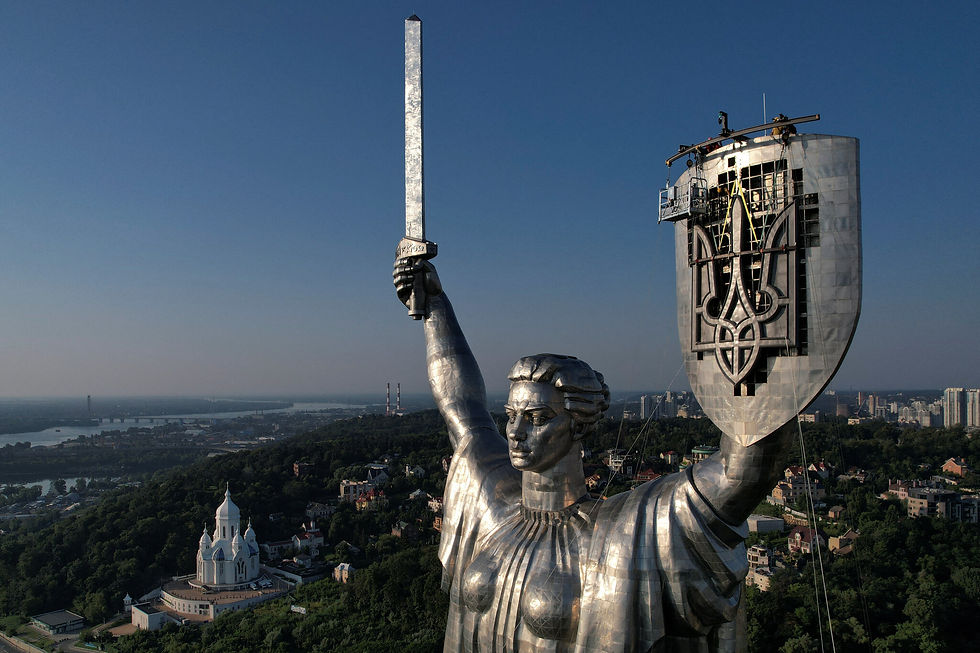
Though the Motherland statues were left to stand after the fall of the Iron Curtain, they have often been altered to reflect local identities in independent states. In 2023, the Soviet hammer and sickle was removed from the Kyiv's Motherland Monument, where it prominently decorated the figure's shield. They were replaced with Ukraine's coat of arms, known as the tryzub. In the aftermath of independence, the tryzub has come to replace Soviet emblems in multiple sites and to reference de-communization in general.
The symbol of the tryzub dates back to the tenth century and came to represent Ukrainian national identity in the early 20th century. In Kyiv's Motherland Monument, this small alteration entirely changed the statue's meaning.

A Fraught Legacy
In the suburbs of the Ukrainian city of Odessa stands a statue of Lenin that has been transformed into Darth Vader by the Ukrainian artist Oleksandr Milov. At another site, the arm of a Lenin monument was transformed into that of a four-time Olympic champion Volodymyr Holoubnychy. In other locations, Lenin statues have been turned into historical figures such as Cossacks, local soldiers who fought in the 19th and early 20th centuries and represent fierce resistance to imperial forces.

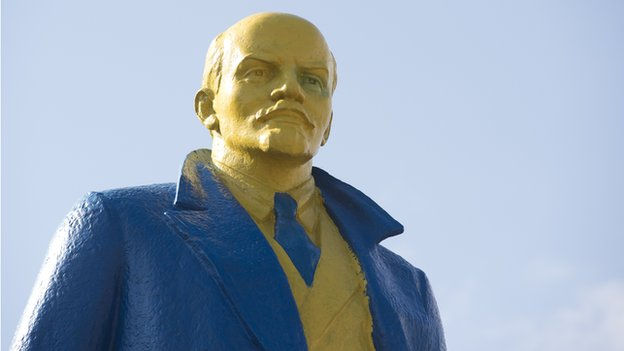
Other statues of Lenin have been painted or decorated in the colors of the Ukrainian flag. These actions could be interpreted in several ways: as an attempt to subvert the original image into an entirely local symbol, a means to both acknowledge and desecrate the meaning of the original statue, or as a symbol of the assimilation of Russian culture into Ukrainian life that recognizes as shared history between Russia and Ukraine. In any case, these creative responses to the historical statues of Lenin suggest just how fraught the relationship is between the new nation of Ukraine and its past.

Comments