

Don't Chatter: Ideology and Control in the Soviet Union
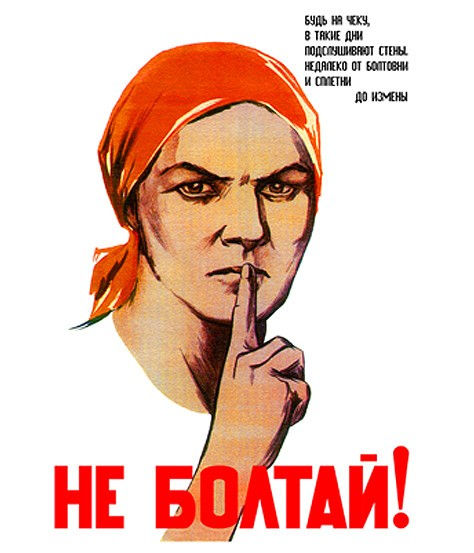
State sponsored images are rarely produced without a psychological motive. They use fear, anger, hope or pride, to influence populations. Political propaganda became especially prevalent during World War I and World War II to boost morale and dehumanize enemies. Totalitarian states like Nazi Germany and the Soviet Union used posters to control public opinion and eliminate opposition. One subset of images created during Stalin’s rule was designed to prevent the population from communicating openly and therefore prevented organized dissent.
One well-known Soviet propaganda poster shows a woman in a red scarf with her finger to her lips in a silencing gesture. She appears stern, with her face looking directly at the viewer. Below her image, in large red letters, the poster reads “Не болтай!” or “Don’t chatter!” To the upper right, an inscription reads “Keep your eyes open. These days even the walls have ears. Chatter and gossip go hand in hand with treason.” The words “with treason” are highlighted in black to emphasize the significance of the misdeed and also the severity of the potential punishment.
The poster was designed by Nina Vatolina in 1941. Born in Moscow and trained at the Moscow Art Institute, Vatolina began making propaganda posters in the late 1930s. Other subjects she portrayed include participation in elections, resistance to the Nazi invasion, and images designed to promote a variety of government initiatives, including agriculture, children's lives and education, health and eugenics, industrialization, post-war reconstruction, international relations, and the development of Siberia.
A Conspiracy of Silence: Vatolina’s famous poster is a similar type to that of the British and U.S. and the fight against war secrets leaking to enemy spies. According to Soviet historian Oralndo Figes, “talking could be dangerous at the best of Soviet times, but during the Great Terror a few careless words were all it took for somebody to vanish forever.” In his book, The Whisperers, Figes documented firsthand experiences of Russian people who lived through the Great Terror. One account from the diary of writer Mikhail Prishvin from 1937, states:
Our Russian people, like snow-covered trees, are so overburdened with the problems of survival, and want so much to talk to one another about it, that they simply lack the strength to hold out anymore. But as soon as someone gives in, he is overheard by someone else–and he disappears! People know they can get into trouble for a single conversation; and so they enter into a conspiracy of silence with their friends.
The Soviet writer Isaak Babel once commented, “Today, a man talks freely only with his wife–at night, with the blankets pulled over his head.” Babel was arrested by Stalin’s security force on May 15, 1939, on fabricated charges of terrorism and espionage, he was executed. Even children were taught to stay silent. One woman cited Figes’s book described her upbringing under Stalin’s rule: “We were brought up to keep our mouths shut. ‘You'll get into trouble for your tongue’-- that's what people said to us children all the time. “We went through life afraid to talk.”
Informers Russian has two words for a “whisperer.” Shepchushchii refers to someone who whispers out of fear of being overheard. Sheptun refers to someone who whispers behind people's backs to the authorities–an informer. According to Figes, “Informers were everywhere–in factories and schools and offices, in public places and communal apartments." It is thought that during Stalin's Great Terror, millions of people reported on their friends, neighbors, and coworkers. Voluntary informers were motivated by political beliefs or material gain. They might be rewarded with money, jobs, housing, special rations, or protection from arrest. Other informers were coerced by the police or influenced by the hope of helping arrested family members. There were also millions of "reliables,” factory and office workers, student activists, watchmen, and others, who were paid to serve as the “eyes and ears” of Stalin’s police and watch over every part of society.
Works Cited: Byran, Anna. “The Soviet Poster Collection.” Wright Museum of Art, Beloit College, 2011, pp. 1–23. Figes, Orlando. The Whisperers: Private Life in Stalin’s Russia. Metropolitan Books, 2007.



Comments